GMRS vs FRS: what is the difference?
Updated October 6, 2026
Short answer
FRS radios need no license in the US and are limited to 2 watts ERP at most. GMRS needs an FCC license that requires no exam and covers family members. GMRS adds 8 repeater input channels on 467 MHz.
Which one needs a license?
FRS radios need no license in the US. Transmitting on GMRS requires an FCC license. There is no exam and one license covers your family members. It lasts ten years. You must be at least 18 years old to get a GMRS license. You apply online through the FCC's license system and pay a fee.
Which channels and how much power?
GMRS has 22 channels that share their numbers with FRS, plus 8 repeater input channels on 467 MHz. FRS radios are limited to 2 watts ERP on channels 1 to 7 and 15 to 22. On channels 8 to 14 the limit is 0.5 watts.
For GMRS the rules differ by station type. Mobile, base and repeater stations may use up to 50 watts on channels 15 to 22. Channels 1 to 7 are limited to 5 watts ERP. Channels 8 to 14 are limited to 0.5 watt ERP. FRS radios must have a non-removable antenna.
Does GMRS reach further?
Walkie talkies send their signal directly from one radio to another. They do not need a cell network. GMRS repeaters can extend range but are optional. GMRS repeaters receive on 467 MHz and retransmit on 462 MHz. That extends the range between radios.
The real range of GMRS and FRS radios depends on terrain, obstructions and the type of station. Range figures printed by makers are maximums under ideal conditions. Rocky Talkie lists 1 to 5 miles as typical in mountains against a 35-mile line-of-sight figure.
Which radios on our shortlist fit each service?
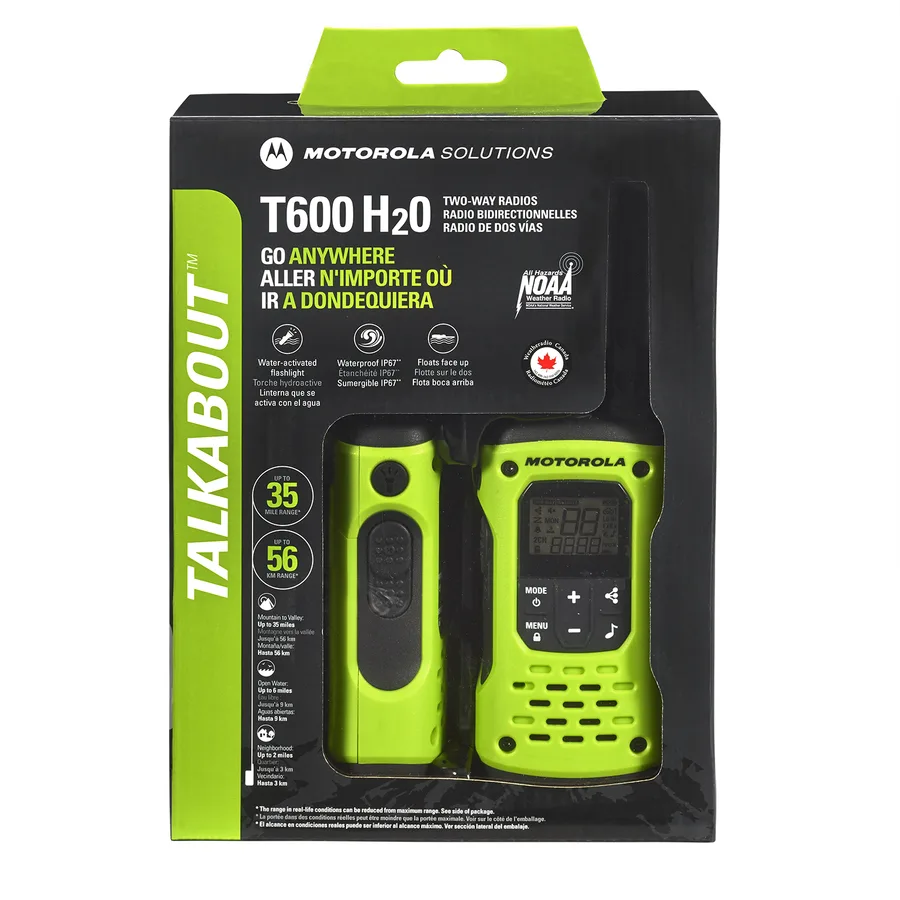
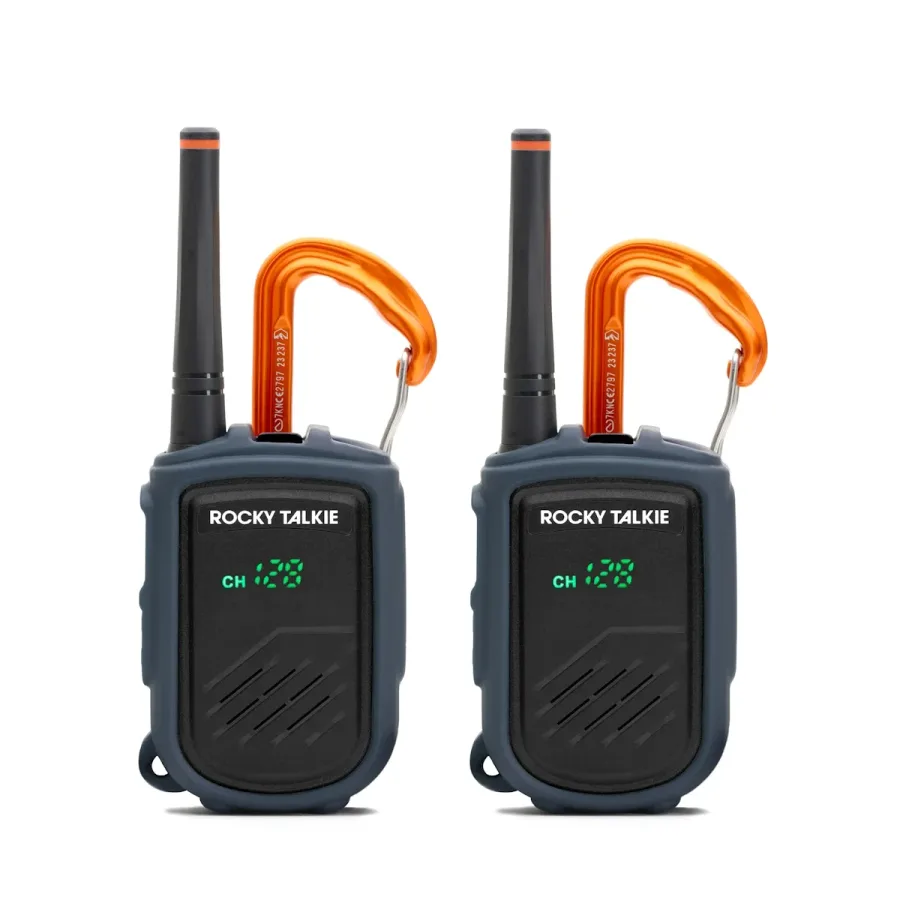
On the FRS side the Motorola Talkabout T600 H2O is IP67 rated and floats face up. It has 22 channels and 11 weather channels with alerts. The Rocky Talkie Mountain Radio runs at the 2-watt FRS maximum and claims 3 to 5 days per charge. Neither needs a license.
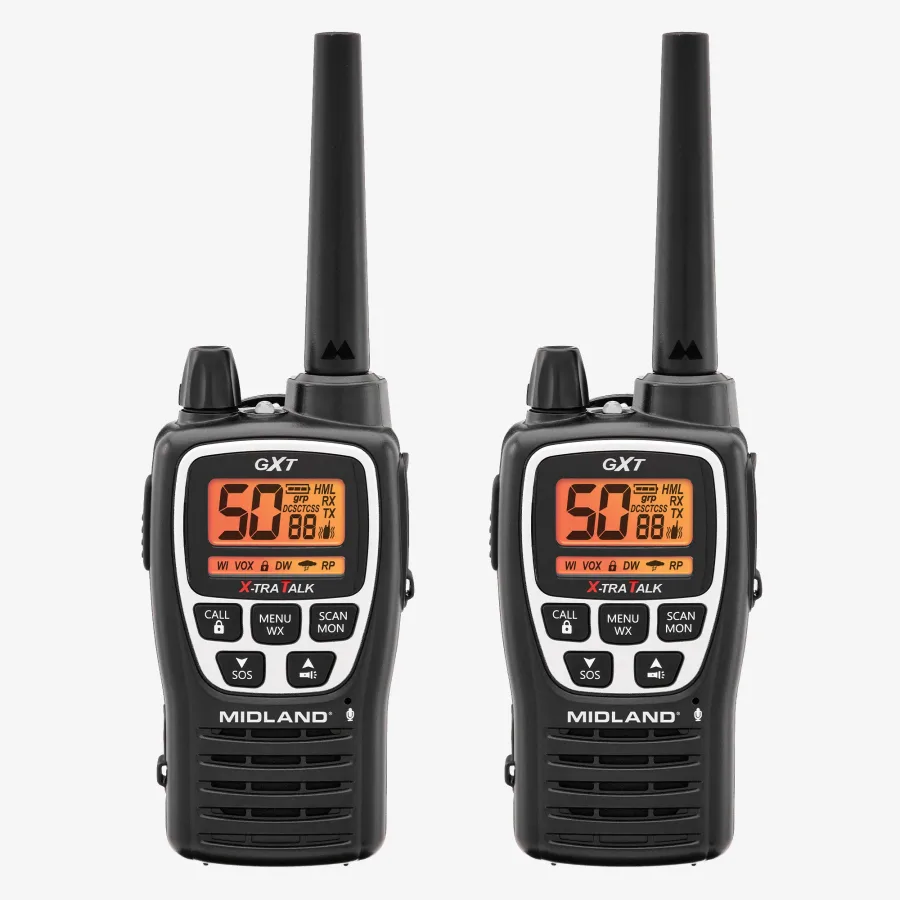
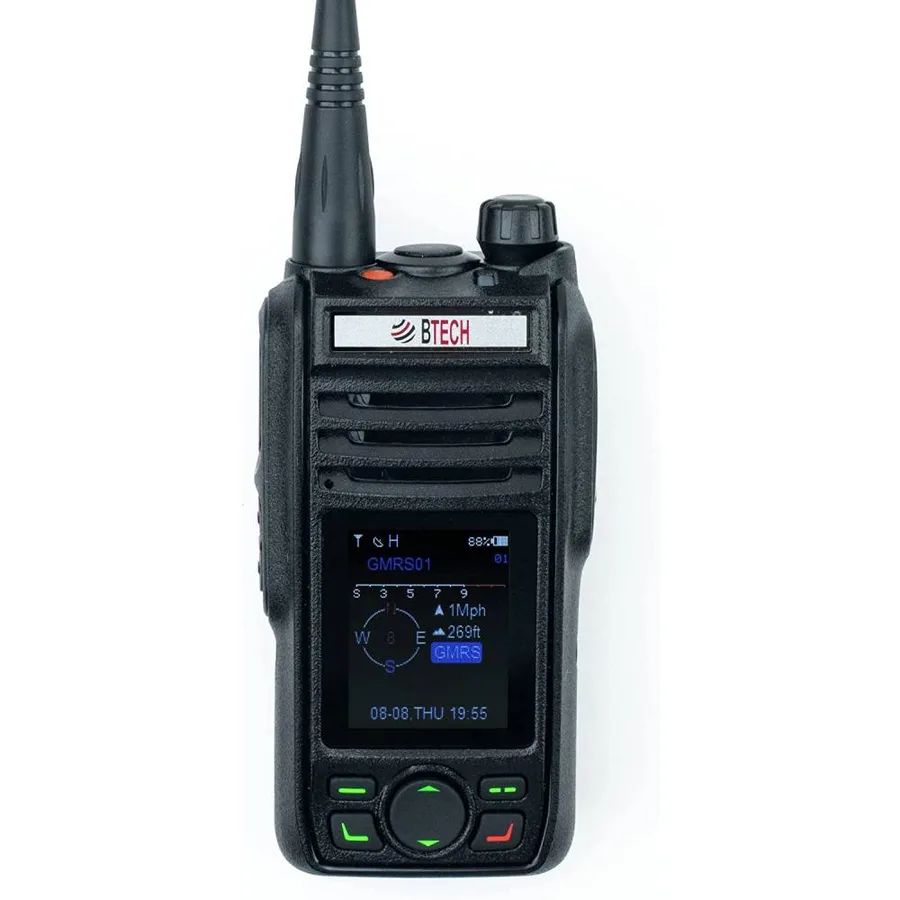
For GMRS the Midland GXT3000VP4 comes as a 2-pack with 50 channels and 8 repeater channels. The BTECH GMRS-PRO is a 5 W handheld with repeater support and an IP67 rating. Both need the FCC license.
- Motorola Talkabout T600 H2O: FRS with 22 channels and NOAA alerts in an IP67 housing that floats
- Rocky Talkie Mountain Radio: FRS at 2 watts with a replaceable Li-ion battery and a carabiner
- Midland GXT3000VP4: GMRS 2-pack with 8 repeater channels and 10 NOAA weather channels
- BTECH GMRS-PRO: 5 W GMRS handheld with repeater support. It also offers Bluetooth app programming and GPS location sharing as two separate functions
From our shortlist
Repeater-capable GMRS pair with NOAA alerts that also runs on three AA cells.
Floating IP67 FRS pair whose flashlight switches on the moment it hits the water.
Five-watt GMRS handheld with off-grid texting and GPS location sharing plus NOAA alerts.
License-free FRS radio built for the mountains with a climbing carabiner and days of battery.
Related questions
Do I need a license for FRS walkie talkies?
No. FRS radios need no license in the US. They are limited to 2 watts ERP on channels 1 to 7 and 15 to 22. On channels 8 to 14 the limit is 0.5 watts. FRS radios must have a non-removable antenna. The Motorola Talkabout T600 H2O and the Rocky Talkie Mountain Radio on our shortlist are FRS.
Who can get a GMRS license?
You must be at least 18 years old to get a GMRS license. It requires no exam, lasts ten years and covers family members. You apply for it online through the FCC's license system and pay a fee. One license covers the family members who use the radios.
Do walkie talkies work without cell service?
Yes. Walkie talkies send their signal directly from one radio to another. They do not need a cell network. GMRS repeaters can extend range but are optional. Some walkie talkies also receive NOAA weather channels and can sound an alert for a warning. The Midland GXT3000VP4 and the Motorola Talkabout T600 H2O both have that alert function.
More questions
Some links on this site are affiliate links. If you buy something after clicking one, the store may pay us a commission. The price stays the same for you, and commissions do not decide which emergency radios we recommend.